
What Is a Traumatic Injury? Causes, Symptoms, Treatment, Types, and Recovery
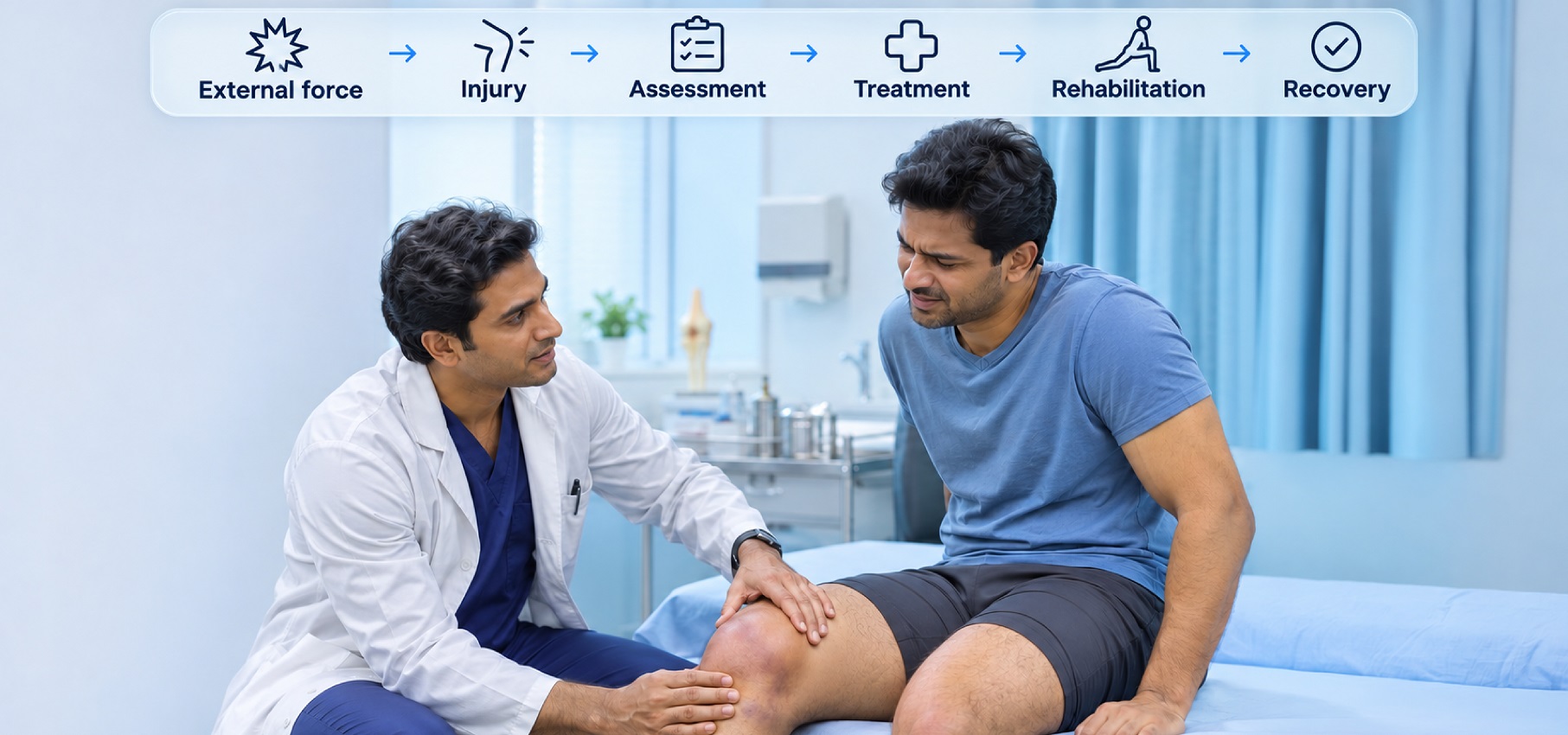
What is a traumatic injury? A traumatic injury is physical damage to the body caused by a sudden external force, such as a fall, road accident, sports injury or direct blow. It can affect bones, muscles, joints, ligaments, tendons or other tissues.
The severity can range from a minor sprain or cut to serious injuries requiring emergency treatment. Recognising the symptoms and getting timely medical care can help prevent complications and support recovery.
This guide explains the traumatic injury definition, common types and causes, symptoms to watch for, treatment options, recovery and when a patient should seek urgent medical attention.
Statistic
According to the Ministry of Road Transport & Highways (MoRTH), India recorded 4,80,583 road accidents in 2023. These accidents resulted in 1,72,890 deaths and injuries to 4,62,825 people across the country. The report also states that 1,60,509 of the reported accidents were fatal accidents.

Understanding how sudden external forces impact bones, muscles, and ligaments.
What Are the Different Types of Traumatic Injuries?
A traumatic injury isn't always a single, isolated problem — the same accident, such as a fall or road traffic collision, can cause more than one type of injury at once, affecting bones, ligaments, tendons and joints together. How severe the damage is depends largely on the amount of force involved and which part of the body absorbs it.
Among orthopaedic patients, musculoskeletal injuries are the most commonly seen, ranging from fractures and dislocations to sprains, strains and tendon injuries. The table below breaks down the main types:
| Type of injury | What it involves | Common example |
| Fracture | Broken or cracked bone | Wrist fracture after a fall |
| Sprain | Ligament injury | Ankle sprain |
| Strain | Muscle or tendon injury | Muscle strain during sport |
| Dislocation | Joint moves out of its normal position | Shoulder dislocation |
| Contusion | Damage caused by a direct blow | Deep bruise |
| Tendon injury | Damage to a tendon | Achilles tendon injury |
Patient example:
A patient presented after a fall with significant wrist pain, swelling and restricted movement. Clinical examination and X-ray imaging confirmed a wrist fracture, after which an individualised treatment plan combining immobilisation and structured rehabilitation was recommended, leading to steady functional recovery.
What Causes Traumatic Injuries?
Traumatic injuries happen in a wide range of everyday situations, often without warning. Road accidents remain one of the leading causes of traumatic injury in India, particularly resulting in significant orthopaedic trauma. Falls are equally common, particularly among older adults, whose reduced bone density and balance make them more prone to fractures from even minor slips.
Younger, more active individuals, on the other hand, are more likely to sustain sports- or road-related trauma, from collisions during play to high-impact accidents involving vehicles. Workplace incidents, including falls from height, machinery accidents and direct impact injuries, also contribute meaningfully to the overall burden of traumatic injuries, especially in industrial and construction settings.
In short, while older adults face a higher risk of fall-related injuries, younger patients more often present with sports- or road-related trauma — underlining why prevention strategies need to be tailored by age group and activity level.
What Are the Symptoms of a Traumatic Injury?
Traumatic injury symptoms vary depending on the injured structure and severity, but common signs include:
- Pain and swelling at the site of injury
- Bruising around the affected bone, joint or soft tissue
- Tenderness when the area is touched or pressed
- Restricted movement or stiffness in the injured limb or joint
- Visible deformity, such as an oddly angled limb
- Severe pain that doesn't ease with rest
- Difficulty bearing weight on the affected leg or foot
Importantly, some serious injuries don't appear severe immediately after an accident — internal swelling, nerve involvement or hairline fractures can take time to show, so persistent discomfort after trauma always warrants proper medical evaluation.

Recognizing key physical signs—from visible deformity to persistent pain—ensures timely medical intervention.
How Is a Traumatic Injury Diagnosed?
Diagnosing a traumatic injury starts with a detailed medical history, where the doctor asks how the injury occurred, when symptoms began and what makes them better or worse. This is followed by a clinical assessment involving a physical examination — checking for swelling, tenderness, deformity and range of motion testing to gauge how much movement is affected.
Depending on the findings, imaging for injuries may be recommended to confirm the diagnosis and assess its extent. Radiography (X-ray) is typically the first step for suspected fractures or bony damage, while an MRI is used when soft-tissue, ligament or nerve involvement is suspected. In some cases, a CT scan offers more detailed imaging of complex fractures, and ultrasound imaging can help evaluate certain soft-tissue or tendon injuries. Together, this musculoskeletal examination and trauma assessment help guide the most appropriate treatment plan.
How Long Does It Take to Recover From a Traumatic Injury?
Traumatic injury recovery time varies widely based on the type and severity of the injury:
- Minor sprains or contusions: usually heal within 1–2 weeks
- Fractures, ligament tears or dislocations: often take several weeks to months, especially where fracture treatment or surgery is involved
- Following the treatment plan: sticking to the prescribed rehabilitation plan supports faster, more complete healing
- Physiotherapy: plays a key role in restoring mobility, strength and function through structured orthopaedic rehabilitation
- Gradual return to activity: easing back in rather than rushing reduces the risk of re-injury
- Watch for red flags: persistent pain, swelling or reduced movement during recovery may need reassessment by a specialist
When Is a Traumatic Injury an Emergency?
Certain traumatic injury warning signs need emergency assessment rather than routine care:
- Severe pain, visible deformity or a suspected fracture-dislocation
- Uncontrolled bleeding requiring haemorrhage control
- Numbness, tingling or loss of sensation, suggesting a neurovascular assessment is needed
- Suspected spinal injury following major trauma
- Increasing pain, tightness or swelling that could indicate compartment syndrome
- Inability to move the affected limb or bear weight
- Signs of shock, such as dizziness or pale, clammy skin
Seek urgent injury treatment immediately if any of these occur, and arrange an orthopaedic consultation as soon as possible for proper assessment and care.
FAQ
Q: Can a traumatic injury cause long-term pain?
Yes, post-traumatic pain can persist due to nerve injury, scar tissue formation or joint instability. Early diagnosis and consistent rehabilitation lower the likelihood of the pain becoming chronic or the healing process stalling.
Q: How do you know if an injury is serious?
Serious injury signs include severe swelling, inability to move, difficulty bearing weight or visible deformity. A neurovascular assessment helps rule out fracture, dislocation, internal bleeding or compartment syndrome after acute trauma.
Q: Can a traumatic injury heal without surgery?
Yes, many injuries respond well to conservative management, including immobilisation, physiotherapy and gradual load progression. This supports natural tissue repair and functional rehabilitation, though fracture healing sometimes still requires surgical intervention.
Q: When should I go to the hospital after an injury?
Get urgent hospital care if you experience warning signs such as uncontrolled bleeding, loss of sensation, suspected spinal injury, or fracture-dislocation, rather than waiting for a routine appointment.
Q: Can an old traumatic injury cause pain years later?
Yes. An old traumatic injury can sometimes cause chronic pain after injury, even after the original injury has healed. Long-term injury pain may develop because of scar tissue, joint degeneration, nerve damage, or lingering soft-tissue damage. In some cases, a previous musculoskeletal injury can contribute to post-traumatic arthritis, leading to stiffness, swelling, or persistent pain years later.
Conclusion
A traumatic injury occurs when a sudden external force damages the body's tissues, bones, joints or other structures. While minor injuries may improve with appropriate care, serious trauma requires timely medical assessment to reduce the risk of complications.
Book a consultation with our orthopaedic specialist for an evaluation of your injury and a treatment plan tailored to your condition and recovery needs.